Barcelona Tests Recast F1 Performance Around Batteries
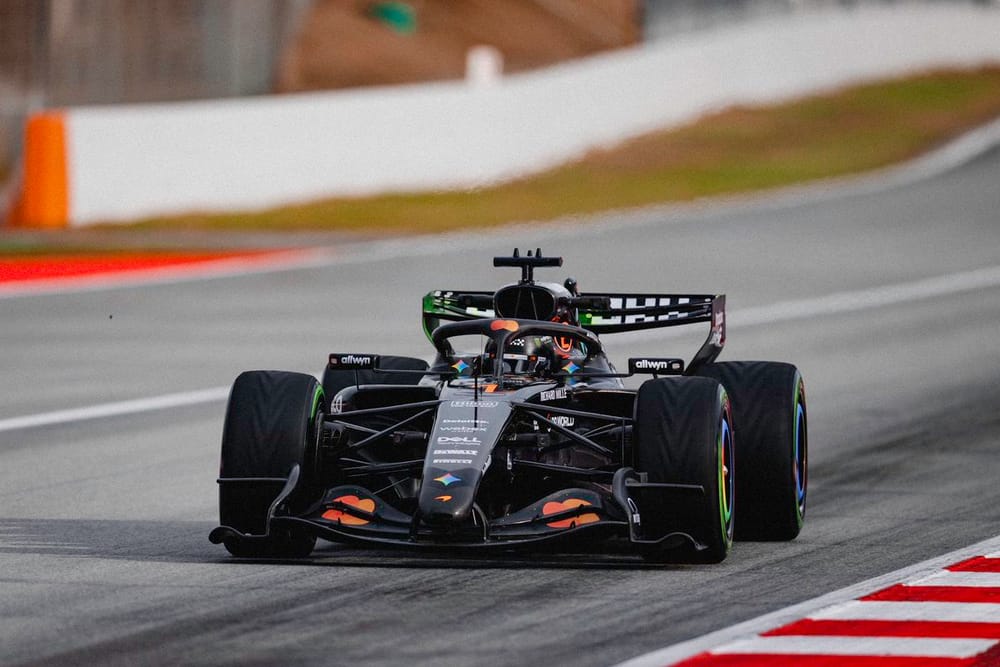
After last week’s Barcelona shakedown, teams and drivers concluded that the 2026 regulation changes have shifted the core performance challenge from purely mechanical grip and corner speed to intensive battery energy management. The new package keeps the 1.6-liter V6 turbo hybrid but removes one recovery motor, increases usable electrical energy roughly threefold into an effectively 4 MJ battery, and pairs that storage with an approximately 350 kW electric unit that supplies nearly half of peak power. That architecture, combined with a ‘‘boost’’ deployment system and tighter state-of-charge rules, produced noticeably larger straight-line speed swings in Barcelona — fully unleashed cars reached roughly 380 km/h while any full depletion of the battery can cost a rival about 350 kW of electric assistance. Teams flagged that battery size is broadly unchanged physically, so hardware, control software and packaging refinements will remain a focus before and during the season.
Drivers reported that many traditional techniques still matter but now sit alongside new, energy-focused behaviors. Competitors including George Russell, Lando Norris, Ollie Bearman and Esteban Ocon said late braking and carrying speed through a corner remain important, yet maximizing harvest requires earlier corner approaches, staying in lower gears more often, and much more precise throttle and rev control on exit. Russell described the cars as “more intuitive” than expected, while Haas principal Ayao Komatsu warned of counterintuitive trade-offs between energy recovery and drivability. Teams expect software and small hardware tweaks to continue; engineers suggested that subtle re-harvesting techniques and mastering micro-deployments could emerge as one of the clearest on-track differentiators.
Those handling and energy-management demands are already reshaping race dynamics and strategy in ways drivers likened to ‘‘speed chess.’’ World champion Lando Norris warned of “more chaos in races,” predicting increased on-track position changes, yo-yoing and defensive moves as drivers time limited electric bursts and manage vulnerability when the battery runs low. Mercedes rookie Kimi Antonelli described the same dynamic as requiring two-steps-ahead thinking, and Norris sketched scenarios where a well-timed boost between two turns creates an overtake but leaves a car exposed later in the lap. With further three-day pre-season running scheduled in Bahrain beginning February 11, teams will use that window to refine when and how to deploy stored energy; the learning curve for both engineering and cockpit technique is expected to continue through the 2026 season.
New Player Signup Bonuses