Author Archives: PressBox

  • USAC Indiana Midget Week kicks off June 9 across six tracks

    USAC Indiana Midget Week kicks off June 9 across six tracks

    The 22nd annual USAC Indiana Midget Week runs June 9–14, a six-night midget car series across six Indiana tracks that is part of the USAC Midget National Championship. It opens June 9 at Circle City Raceway in Indianapolis, then moves to Paragon on June 10, Lincoln Park in Putnamville on June 11, Bloomington Speedway on June 12, Tri-State Speedway in Haubstadt on June 13 and concludes at Kokomo Speedway on June 14. The Paragon program on June 10 will mark the 100th Indiana Midget Week feature in the series’ history.

    The weeklong championship awards $15,000 to the Indiana Midget Week champion. The condensed, high‑intensity schedule and variety of tracks emphasize stamina and mechanical reliability as much as outright speed, and the format can strain team logistics and driver workload. Sprint cars will serve as the nightly support class, and many competitors are expected to attempt double duty between midget and sprint machines.

    Several established names and emerging talents figure to shape the six‑night chase. Defending champion Kale Drake returns to defend his title in the RMS Racing No. 4, and Cannon McIntosh will rejoin the Keith Kunz/Curb‑Agajanian No. 71K entry for all six nights. Jacob Denney leads the USAC National Midget standings with 150 points, followed by Kevin Thomas Jr. (149) and Justin Grant (147). Denney was the only multi‑time Indiana Midget Week winner in 2025 and most recently won at Kokomo in April. Preview lists also cite veterans and rising drivers, including Jakeb Boxell, Zach Wigal and Gavin Miller, as potential contenders for individual nights.

    More
  • Ezpeleta: holeshot devices out by 2027, action could come sooner

    Ezpeleta: holeshot devices out by 2027, action could come sooner

    MotoGP officials and riders moved to overhaul start-line procedures and grid formation after a string of first-corner pile-ups culminated in a five-rider crash at the Hungarian Grand Prix. Jorge Martín admitted sole responsibility for the Balaton Park collision that collected Marco Bezzecchi, Fabio Di Giannantonio, Raúl Fernández and Fermín Aldeguer, and he was handed a double long-lap penalty for the next race. The incident followed an earlier violent turn-one crash in Barcelona that required Johann Zarco to undergo surgery, and the sequence of accidents has reignited debate about start-line safety, including whether holeshot and ride-height devices should be banned and whether resurfaced low-grip asphalt at Turn One contributed to the pileups.

    Series officials and teams have opened several concrete proposals to reduce first-corner risk. Organizers agreed to increase the distance between the three starting positions on each row by three meters, a change scheduled to take effect at the German Grand Prix before the summer break. Trials have already been held of a two-rider-per-row formation, and Sky Italia and others have suggested testing an F1-style staggered start to give riders more room into Turn One. Chief Sporting Officer Carlos Ezpeleta said holeshot devices “will not be here in 2027” and indicated officials are discussing whether action on starting devices can be taken this year, with further formal decisions expected from governing bodies and race directors.

    Stakeholders remain divided on causes and remedies. Jack Miller publicly urged the immediate removal of the front start device, saying Martín’s bike “jumped” when he tried to remove it and pointing to slippery new asphalt and higher approach speeds at Balaton as factors. Aprilia CEO Massimo Rivola rejected the device theory and blamed rider error. Observers warned that wider grid separation could disproportionately disadvantage Martín because qualifying has been his biggest weakness this season. Former rider Virginio Ferrari cautioned that rule changes alone will not solve the problem and called for a broader safety effort through rider education, while officials continue investigations into the recent crashes and weigh a mix of procedural, technical and cultural responses.

    More
  • Stella: Mercedes customer status put McLaren on the back foot

    Stella: Mercedes customer status put McLaren on the back foot

    Andrea Stella said McLaren felt being a Mercedes customer put the team “on the back foot” in the 2026 Formula 1 season, blaming the customer-supplier arrangement for operational and integration limits that have compounded reliability problems. He said the new 2026 power units remain largely unknown and teams are still learning how to run them session by session. As a customer, McLaren has had fewer opportunities to align timelines with Mercedes High Performance Powertrains, to run joint experiments or to pair chassis tests with extended power-unit running in the way a works team can, Stella said, and that constrained McLaren’s development and response this season.

    The limits of that arrangement showed up across race weekends. McLaren, the defending world champion, produced a double-podium in Miami but then endured disrupted events in Montreal and Monaco. Lando Norris retired in Montreal with a gearbox failure after a strategic gamble on intermediate tyres, and he was forced to retire in Monaco with a power-unit problem. McLaren also recorded a rare double did-not-start in China and has faced a difficult opening stretch to the year. Stella accepted that some failures, including the Canadian gearbox issue, were McLaren’s responsibility.

    McLaren and Mercedes HPP are conducting a wide-ranging, ongoing review of individual items and broader factory-to-track processes to improve meetings, information sharing and reliability. Stella stressed Mercedes HPP was not deprioritising McLaren and said the relationship remains strong, but he warned that fixes will take time. McLaren’s leadership is also weighing strategic alternatives, with CEO Zak Brown saying the team could consider building its own power unit in future if it proved financially viable. The season marks the first time McLaren has publicly said its customer status produced these kinds of downsides.

    More
  • Hulkenberg's Monaco restart clip forces Sainz out, earns 10s penalty

    Hulkenberg’s Monaco restart clip forces Sainz out, earns 10s penalty

    Nico Hülkenberg’s contact with Carlos Sainz at the Monaco Grand Prix restart forced Sainz to retire, earned Hülkenberg a post-race 10-second penalty and provoked strong criticism of restart driving. Sainz called the manoeuvre “stupid” and described the late-race contacts as “borderline unacceptable.” Hülkenberg defended his actions, saying he had to take evasive action to avoid Esteban Ocon, was pushed onto the inside kerb and did not accept full blame for the collision.

    The incidents unfolded at the Lap 70 restart with seven laps remaining, as the pack bunched up. Hülkenberg, who had taken the restart in 12th, attempted an inside move on Ocon at the Loews Hairpin (Fairmont Hotel Hairpin) and clipped Sainz’s left rear. Sainz, who had been running 10th, limped on to Portier before being struck again by Franco Colapinto and retiring with terminal damage to his Williams. Race stewards ruled that Hülkenberg “turned into Car 55 in Turn 8 causing a collision,” reviewed both the hairpin and Portier incidents, issued Hülkenberg a 10-second penalty for the hairpin contact and took no further action over the Portier contact after concluding Sainz had tried to move off the racing line following damage.

    The penalty dropped Hülkenberg from ninth across the line to 13th in the final classification and directly affected lower points positions, denying Williams a potential double-points result. The sequence and the stewards’ interpretation heightened debate about restart dynamics and on-track behaviour, with contrasting accounts from the drivers involved.

    More
  • Haudenschild ends 21-race skid, earns 48th career win in Plymouth

    Haudenschild ends 21-race skid, earns 48th career win in Plymouth

    Sheldon Haudenschild turned an emotional personal loss into a comeback victory at the World of Outlaws NOS Energy Drink Sprint Car feature at Plymouth Dirt Track in Plymouth, Wisconsin. Haudenschild learned his dog, Pella, had died the morning of the race, and he broke a 21-race winless streak with a win that was his second of the season and the 48th of his career. The triumph produced a visibly emotional response from Haudenschild.

    Haudenschild rallied from as low as eighth during the 35-lap feature, charging forward to pass Michael “Buddy” Kofoid with five laps remaining to take the lead. The decisive stretch came during a seven-lap shootout that followed after David Gravel clipped a rut in Turn 4, slammed the Big Game Motorsports No. 2 into the wall and suffered severe rear-end damage that ended his night. Kofoid finished second for his 11th podium of the season. Garet Williamson scored his best result of the year in third and extended his streak to four straight top-10s. Cole Macedo finished fourth and Carson Macedo was fifth, with the race run before a record crowd at Plymouth Dirt Track.

    More
  • FIA to publish ADUO data; Hamilton warns gap closing will take months

    FIA to publish ADUO data; Hamilton warns gap closing will take months

    The FIA’s Additional Development and Upgrade Opportunities (ADUO) benchmarking identified Red Bull Ford Powertrains’ DM01 V6 as the internal combustion engine (ICE) benchmark. Assessments based on measurements taken after the Canadian Grand Prix and communicated to manufacturers at the Monaco Grand Prix led to targeted development allowances for rivals: Motorsport.com and PlanetF1 reported that Mercedes sat just over 2 percent behind the benchmark, while Ferrari, Honda and Audi were assessed at more than 4 percent behind. Ford motorsport boss Mark Rushbrook praised the Milton Keynes collaboration that produced the DM01.

    Under ADUO, entitlement is set by an ICE performance index that measures engine speed, torque and MGU‑K output and excludes energy deployment and battery performance. Manufacturers receive one homologation token for roughly every 2 percent shortfall versus the benchmark; those tokens expand homologation scope, add dyno hours and provide targeted cost‑cap relief to permit development outside the normal regulatory windows. Reports said Mercedes’s deficit earned it one extra homologation upgrade for the current season and another in 2027, while Ferrari, Honda and Audi were each allocated two homologation upgrades this season and two in 2027. Some accounts differ on Audi’s precise allowance—PlanetF1 said Audi qualified for at least one ADUO allowance and noted Audi’s main deficit while it develops its first F1 power unit.

    Drivers and teams acknowledged the scale of the task ahead. Lewis Hamilton said using the extra development allowances to close the gap would be a long project — “roughly eight to ten months.” The FIA has not yet published the full ADUO benchmarking data and an official announcement could follow within days. The body also plans a further ADUO review covering races from Monaco through the Hungarian Grand Prix; a later assessment could alter upgrade opportunities.

    More
  • Marc Márquez seals 100th MotoGP win from pole at Balaton Park

    Marc Márquez seals 100th MotoGP win from pole at Balaton Park

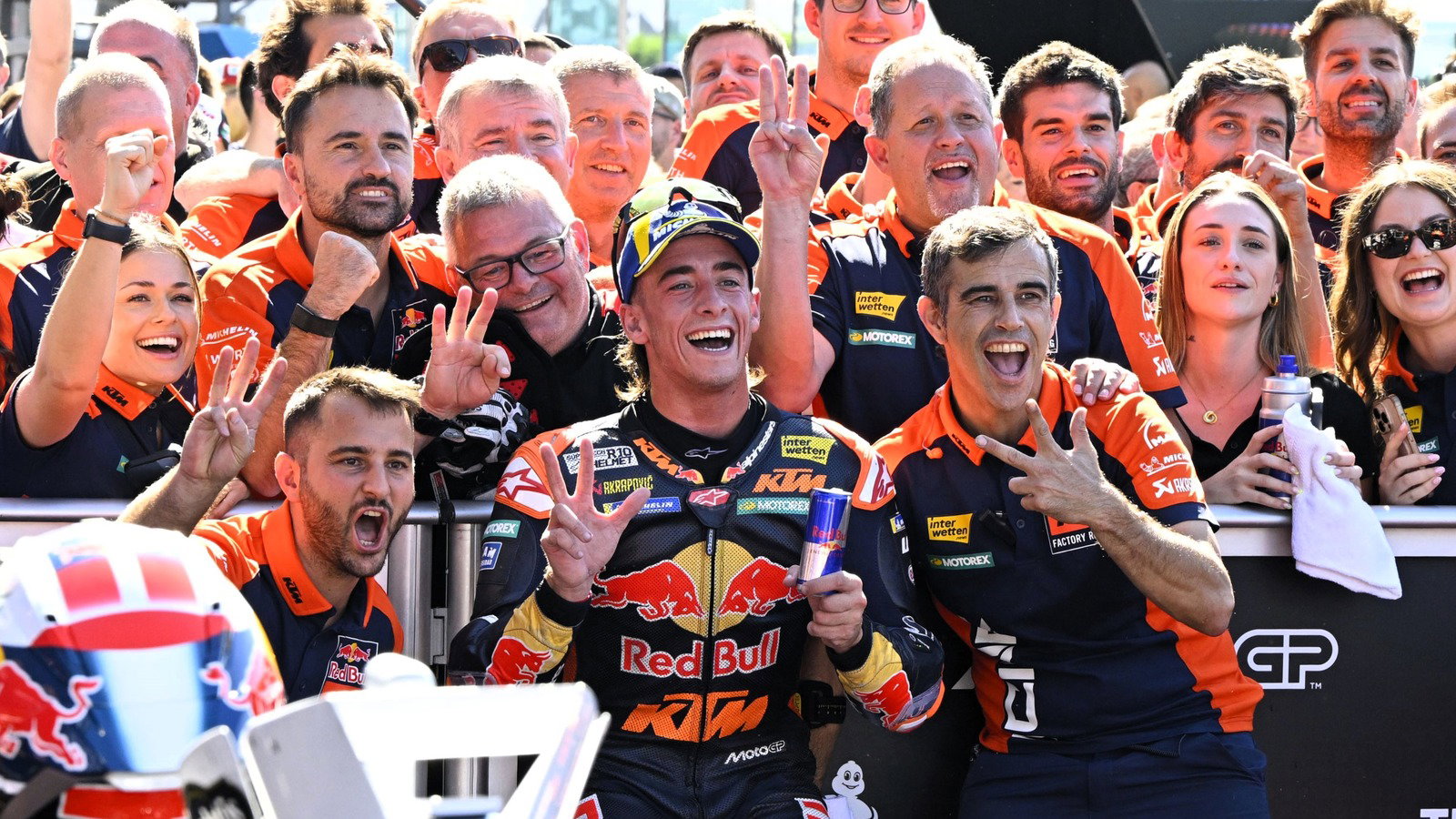
    Marc Márquez claimed a milestone victory at the Hungarian Grand Prix at Balaton Park, converting pole into a lights-to-flag Grand Prix win that marked his 100th MotoGP victory and his first full-distance victory of 2026. Márquez had already won Saturday’s Sprint to complete a Balaton Park double, reclaimed the lead on lap 17 of the main race and then pulled away to deny late challenges, with Pedro Acosta finishing second and Francesco Bagnaia third.

    The race featured a chaotic opening-lap Turn 1 collision when Jorge Martín lost control under braking and struck teammate Marco Bezzecchi, also collecting Fabio Di Giannantonio, Raúl Fernández and Fermín Aldeguer. Bezzecchi and Martín were checked and suffered no fractures, and race officials launched an investigation into the incident. Di Giannantonio rejoined from the back and recovered to tenth, Joan Mir crashed out on lap 15, Fabio Quartararo retired and the works Yamahas finished outside the top 10. Stand-in Iker Lecuona scored points in eighth and Jack Miller finished seventh.

    Márquez’s victory cut into Marco Bezzecchi’s championship lead, reducing the margin by 25 points and reshuffling the early-to-mid-season standings with 14 rounds remaining. The Balaton Park result also left Fabio Di Giannantonio six points clear of Pedro Acosta in the standings and moved Ai Ogura ahead of teammate Raúl Fernández into sixth. The meeting took place amid broader safety conversations for first-corner starts, with MotoGP set to trial a two-per-row grid at Balaton Park and other measures under consideration.

    More
  • Stewards close Monaco probe; Hadjar's Red Bull podium stands

    Stewards close Monaco probe; Hadjar’s Red Bull podium stands

    Stewards closed a post‑race probe into an alleged red‑flag infringement at the Monaco Grand Prix and took no further action, leaving Isack Hadjar’s promotion from fourth to third intact. Hadjar recorded his first podium as a Red Bull driver and said he suffered massive driveability issues and limited power during the race.

    The Technical Delegate’s Report says mechanics worked on car No. 6 during the red‑flag suspension at about 16:55 performing operations that were not permitted. The report states the team stopped the work, reverted the car to its previous state and did not replace parts; a later document added the team had attempted to change spark plugs or coils but did not proceed.

    Alpine has formally requested a Right of Review with the FIA over two five‑second pit‑lane speeding penalties given to Pierre Gasly. The penalties — for exceedances of the 60 km/h pit‑lane limit by 0.1 km/h and 0.4 km/h — added 10 seconds and dropped Gasly from crossing the line third on track to seventh in the final classification. Gasly, who recovered from ninth during the race and crossed the line third after late moves, said he had activated the pit‑lane speed limiter correctly and that team data would show he was below the limit. Paddock voices suggested some detections might be linked to drivers’ pit‑lane entry lines. George Russell, Oscar Piastri and Lewis Hamilton were also penalised for pit‑lane speeding in Monaco.

    Alpine said it hopes an appeal or the FIA Right of Review could overturn the penalties and restore Gasly’s podium; the FIA’s decision will determine whether the official race classification changes. Sources noted that if the FIA reverses the sanctions against Gasly, Hadjar would be required to surrender the result. A successful reversal would also extend Alpine’s lead in the championship after Red Bull had trimmed the gap to two points with a double points haul at Monaco.

    More
  • Two crashes at Turn 19 force Monaco inspection and red flag

    Two crashes at Turn 19 force Monaco inspection and red flag

    Charles Leclerc’s retirement from the Monaco Grand Prix followed what he described as a major brake failure, prompting inspections by Ferrari and race officials and raising fresh concerns about the track surface at the final corner. Leclerc crashed at the Anthony Noughes corner, Turn 19, during a restart and was forced to retire from his home race. He told team radio and media that three of his four brakes had failed, saying the front left was working, the front right was only half-working, and both rear brakes showed no deceleration. Leclerc said the problem began during the first safety car period, rejected suggestions that loose asphalt caused the incident by saying “data speaks for itself,” and expressed visible frustration on the radio, striking his steering wheel. He called the sequence “an absolute nightmare” and said “I look like an idiot.” Leclerc also said Ferrari had identified a solution and that he planned to adopt “Lewis’s configuration” for the next race.

    The crash came shortly after Lance Stroll had hit the identical spot at the same final corner, bringing out the safety car. Stroll’s collision prompted Ferrari and race officials to inspect the circuit, and Leclerc’s subsequent accident triggered a second safety car and a red flag that halted the event. Race Director Rui Marques ordered a track inspection, and the FIA said the race was stopped to allow inspection of surface break-up at Turn 19. The track surface had broken up at the final corner, and officials paused the race to assess the extent of the damage and whether racing could resume safely.

    The twin incidents at Turn 19 interrupted the race sequence and have focused attention on both brake reliability and track integrity. Ferrari and race stewards said brake reliability would be a subject of investigation ahead of the next round, and the FIA-led inspections of the damaged Turn 19 remain central to determining the causes and any safety measures required before racing resumes at the circuit.

    More