WSL Sells Stake in Kelly Slater's Surf Ranch, New Owner Not Disclosed
| May 8, 2026
WSL Sells Stake
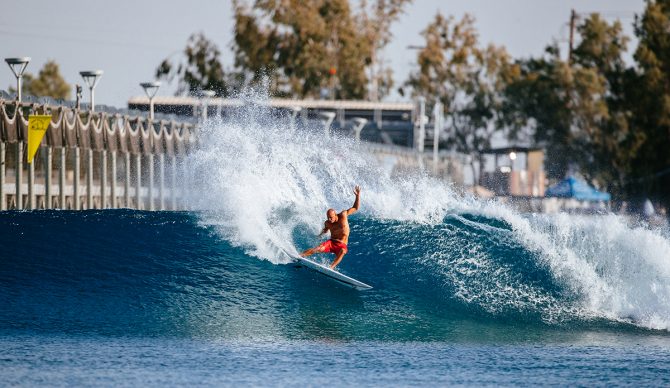
The World Surf League quietly sells its stake in Kelly Slater’s Surf Ranch, a change several sources confirm even though neither the league nor Kelly Slater Wave Co. issues a public statement. The transaction remains understated in the public record: Kaniela Neves, president of the Surf Ranch, acknowledges the deal but says the company has not yet formally released acquisition details, and the league does not respond to requests for comment. That lack of formal notice leaves key facts unresolved, including who ultimately controls the facility now. One public signal points to Los Angeles investor Joseph Self updating his LinkedIn profile to show a partnership beginning in February 2026, but the transaction itself lacks an official announcement from the parties that previously managed or owned the venue. The sale therefore reads as an operational shift that the organizations involved prefer to keep out of full view for the moment, even as people familiar with the situation confirm the change to reporters.
For context, the Surf Ranch is not an incidental asset in modern professional surfing. Kelly Slater first reveals the site in December 2015, and the WSL moves to a majority acquisition in May 2016, establishing the venue as a touchstone for wave-pool innovation. It hosts Championship Tour events in 2018, 2019 and 2021 and continues to operate commercially; industry reports note the facility rents for as much as $70,000 a day. Those facts underline why a quiet divestment draws attention: the Surf Ranch is both a technical showcase — a place that proved wave-pool surfing could be staged at the highest level — and a commercial property that has generated event and rental revenue. The immediate practical upshot of the sale is therefore both symbolic and operational: one of the sport’s most visible bespoke venues moves out of the league’s majority control at the same time the WSL is rethinking where and how it stages big, produced events. The interplay between ownership, commercial use and the WSL’s competition calendar makes the shift consequential even without a formal press release detailing buyers, terms or an explicit strategic rationale.
Wave-Pool Strategy Shift
The WSL frames the divestment against a broader strategic realignment that begins under CEO Ryan Crosby’s hiring in 2024, a change the league ties to refocusing on core surf audiences and adopting a revamped tour format. Under that leadership, the league shifts wave-pool emphasis away from the Surf Ranch and instead invests in the Middle East, building Surf Abu Dhabi in 2024 and adding that venue to the Championship Tour in both 2025 and 2026. The timing of those moves makes the sale of the Surf Ranch understandable as part of a reallocated investment in different markets and facilities: the league’s wave-pool activity migrates geographically and operationally, and the Surf Ranch’s role as the centerpiece of WSL-controlled wave-pool competition diminishes. That recalibration also follows a clear tonal change from the era led by Erik Logan, when the league pursues non-endemic audiences more aggressively and experiments with programming such as a reality show. The contrast between those approaches is evident in the league’s choices on venues and in how it positions its events — an outward push into new regions and new formats rather than doubling down on the facility it once majority-owned.
The practical consequences extend beyond branding. By shifting flagship wave-pool events to Surf Abu Dhabi — a facility the WSL constructs and then incorporates into consecutive Championship Tour seasons — the league signals a strategic preference for the logistics, partnerships and market dynamics available in that region. The Surf Ranch remains a commercially active asset that continues to rent for substantial sums and to serve as a technical landmark in surfing’s evolution, but the WSL’s sale of its stake indicates a decision to let that property operate in a different ownership structure while the league concentrates its competitive slate elsewhere. The transaction therefore reads as two concurrent narratives: one of ownership change at a high-profile surf venue, acknowledged quietly by company leadership and hinted at through public profile updates, and one of an institutional reorientation by the WSL under new leadership and a new tour model. Until the Surf Ranch’s new ownership and the terms of the transaction are made explicit, stakeholders inside and outside the sport will judge the move by the league’s broader strategic choices — where it stages its Championship Tour events, how it serves core surf audiences, and how it balances innovation in wave technology with commercial and regional partnerships.
New Player Signup Bonuses