NXTbets Inc

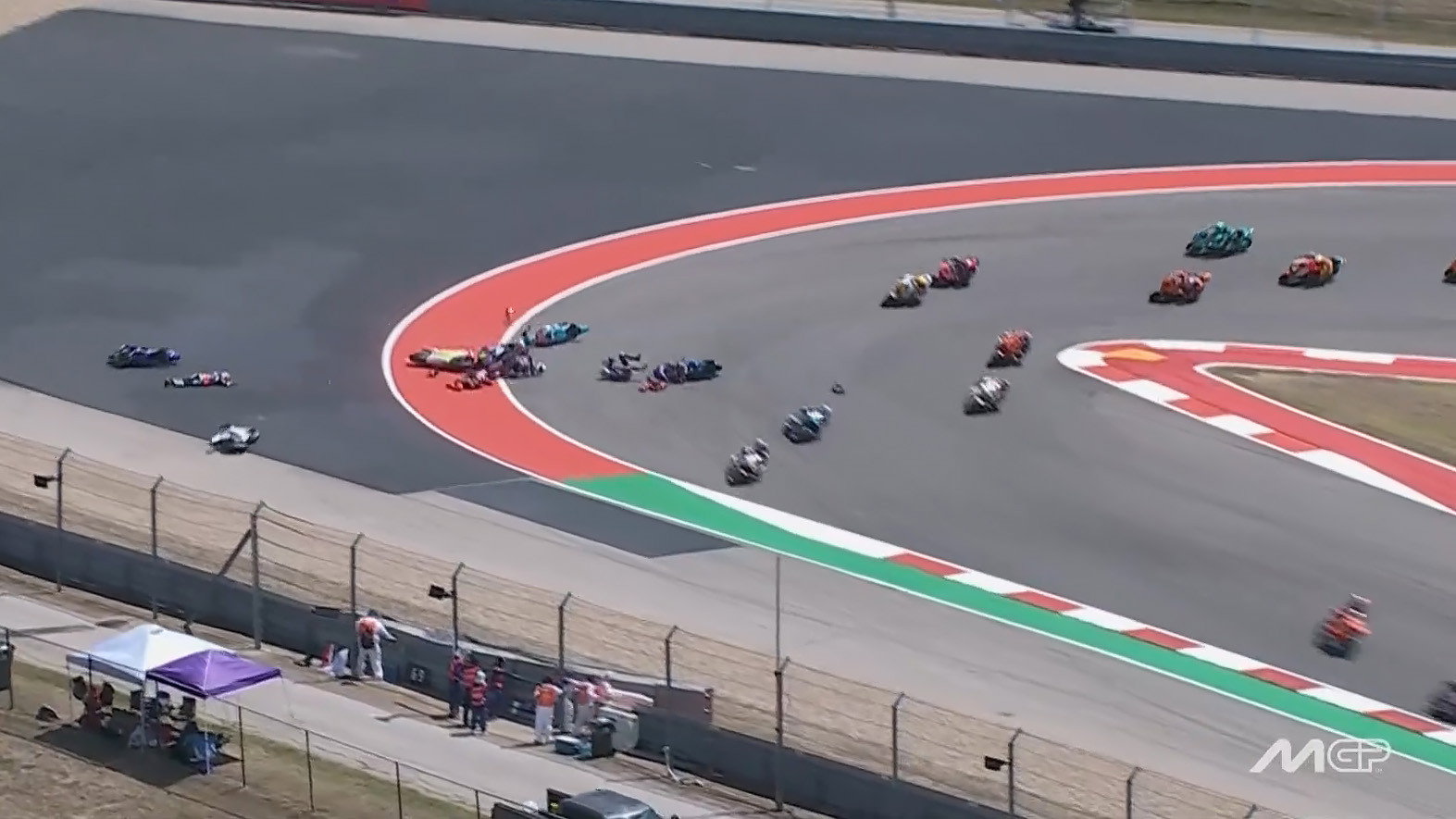
  • Trailing Aldeguer at Turn 1, Bagnaia crashes out on lap 11

    Trailing Aldeguer at Turn 1, Bagnaia crashes out on lap 11

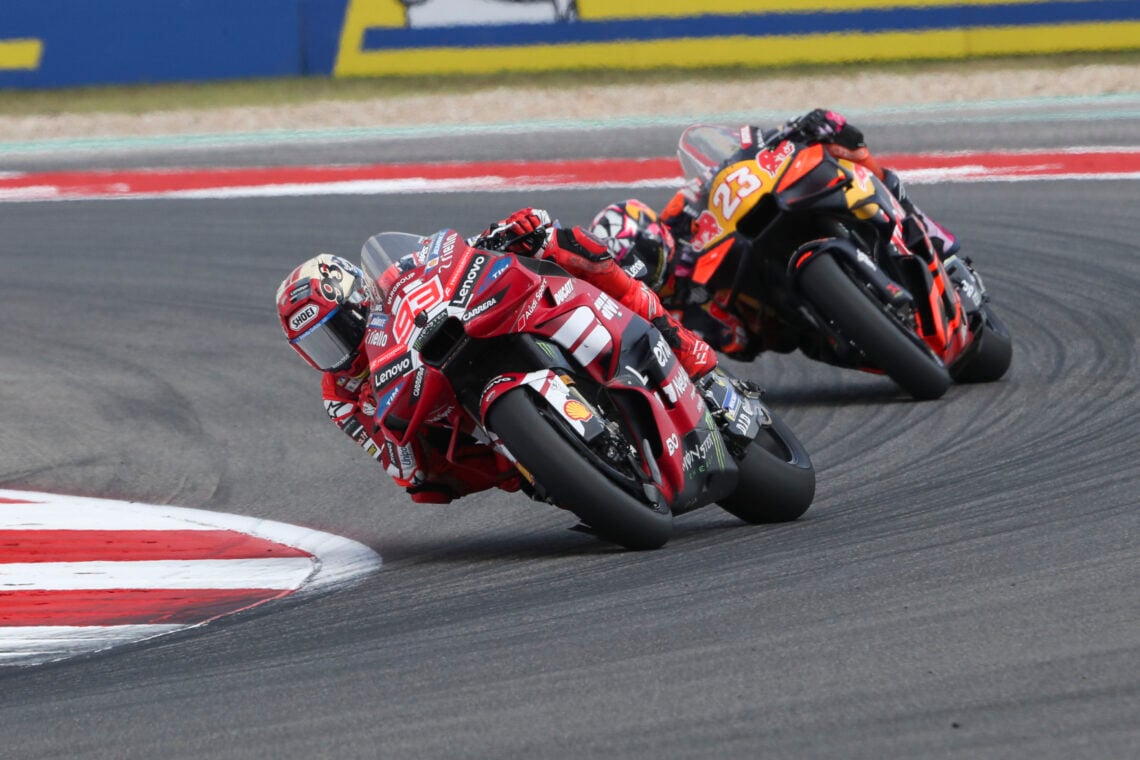
    Francesco “Pecco” Bagnaia’s Brazilian weekend was defined by two crashes and a DNF. A Q2 crash early in the weekend left him with a lower-grip backup Ducati and a compromised starting position (he qualified and started 11th).

    In the shortened 23-lap Goiânia GP he crashed again on lap 11 while trailing Fermin Aldeguer at Turn 1 — the second crash of the weekend and his first DNF of the season.

    After the race he said, “I was just trying to hang on; I couldn’t stay on the bike,” that he had been “trying to survive,” and that he felt “at the mercy of what the bike was doing.”

    More
  • Sinkhole and Track Failure Delay Goiania MotoGP; Laps Cut

    Sinkhole and Track Failure Delay Goiania MotoGP; Laps Cut

    Heavy Thursday flooding at the Goiania circuit and a sinkhole discovered after qualifying disrupted the weekend and forced lengthy repairs, delaying the program by roughly 75–90 minutes. The interruption pushed the Sprint back and moved Moto2 qualifying to Sunday; late resurfacing work and visible surface failure on the pit straight further delayed the event.

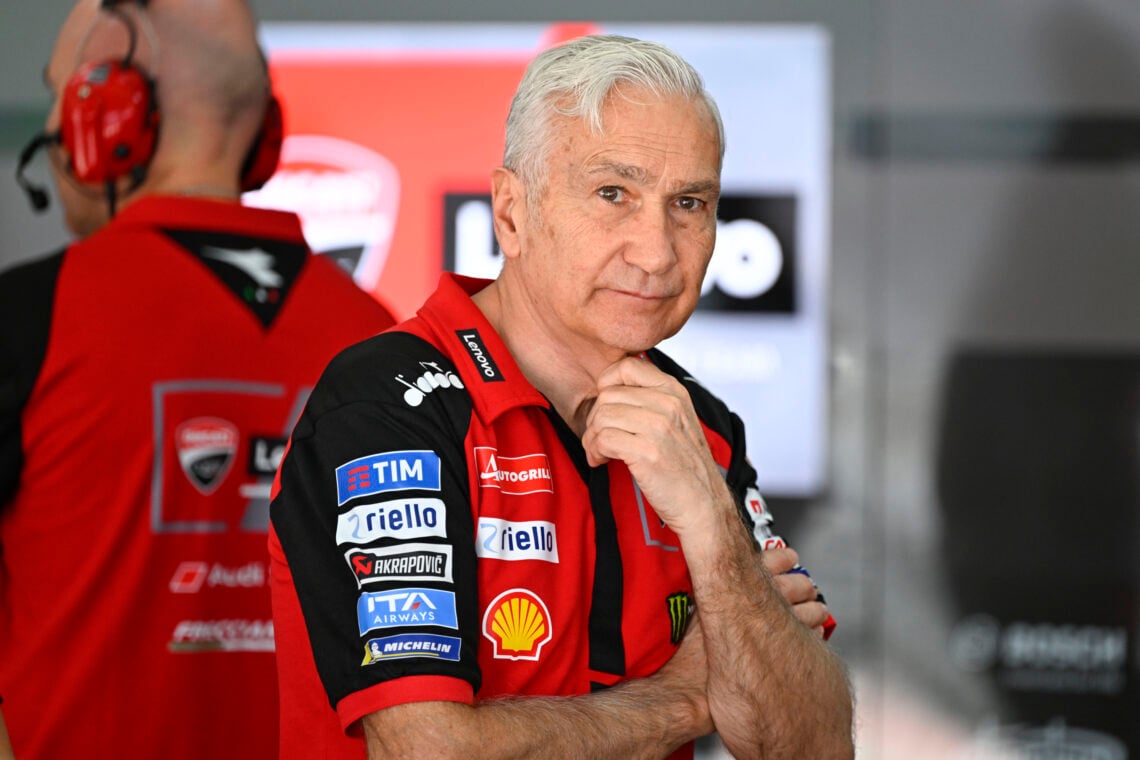
    Race Direction cut the feature race from 31 to 23 laps minutes before the start after track degradation became apparent. Parts of the circuit were reported to be breaking up and striking riders, prompting safety concerns and an on-camera confrontation between Aprilia team principal Davide Tardozzi and MotoGP boss Carlos Ezpeleta. The lap reduction came after riders had already locked in tire choices, a change teams and riders said affected strategy and outcomes.

    Despite the disruption, Marco Bezzecchi led from the start of the shortened grand prix and took victory, holding off teammate Jorge Martín to give Aprilia a 1–2. Bezzecchi’s winning margin was about 3.2 seconds; it was reported as his second win of 2026 and extended his championship lead to 11 points. Some outlets described the result as Aprilia’s first premier-class one-two, while others noted it was the manufacturer’s fourth consecutive MotoGP win. The podium was completed by polesitter Fabio Di Giannantonio, who held off Marc Márquez—Márquez having won the Sprint the previous day. Several high-profile riders crashed out during the grand prix, including Jack Miller, Francesco Bagnaia (lap 11), Joan Mir and Brad Binder. Teams and riders said the weekend was defined as much by unusual circuit failures and extreme tire degradation as by the on-track contest. Jorge Martín said the hole was “off the racing line” and that “we could race even with the hole,” but mixed conditions—from heavy rain and flooding early in the weekend to scorching temperatures during the race—complicated set-up and tire strategy. With safety concerns and post-race controversy still under discussion, the championship moves on to the next round as teams assess the circuit damage and the decisions taken in Goiania.

    More
  • Razgatlıoğlu calls Pramac Yamaha 'impossible' after Sprint

    Razgatlıoğlu calls Pramac Yamaha ‘impossible’ after Sprint

    Toprak Razgatlıoğlu blamed his poor showing in Saturday’s Brazilian MotoGP Sprint on a loss of front-end grip and multiple technical and electronic problems with the Pramac Yamaha V4, calling the race “frustrating, a step back” and describing the bike as “impossible” to ride. He reported a clutch/power problem at the start that dropped him back, a mysterious loss of power on throttle release, and severe front-end instability under braking that left him “afraid to brake” and feeling the tires “like they were five years old.” Razgatlıoğlu and teammate Jack Miller were the only riders to experience the same issues, and he said the bike “wasn’t the same” compared with Friday’s running.

    Those problems produced a heavy on-track toll: Razgatlıoğlu, who had qualified 12th after a strong Friday that included a surprise P3 and his first Q2 appearance, finished 18th in the 15‑lap Sprint, beating only Miller, with both Pramac Yamahas ending at the back of the field. Marc Márquez won the Sprint, finishing roughly 23 seconds ahead, while the Pramac duo were about 15 seconds behind Fabio Quartararo and nearly eight seconds behind Alex Rins; Quartararo ran a soft rear tire to sixth while the Pramac riders had chosen medium rears. Miller, who briefly led after starting 18th, battled strong understeer and a lack of front-end confidence, and both Pramac bikes were passed late by Franco Morbidelli and Enea Bastianini. The whole grid struggled with the hard front tire over the Sprint.

    Pramac said it would investigate setup and electronic systems to address the clutch/power and handling problems, and team boss Campinoti’s crew planned comprehensive checks ahead of Sunday’s Grand Prix. Razgatlıoğlu’s preparation had already been disrupted by an FP2 crash he attributed to a technical fault, an incident that, with an earlier retirement in Thailand, brought his crash tally to two. He expressed hope the team’s checks and the full race would uncover the issue and deliver a better result, and Miller suggested a wet forecast for Sunday might improve their prospects.

    More
  • Telemetry shows Márquez 348.3 km/h, Quartararo 336.4 deficit

    Telemetry shows Márquez 348.3 km/h, Quartararo 336.4 deficit

    Fabio Quartararo used telemetry from the Brazilian weekend to quantify the Yamaha V4 M1’s top-speed and horsepower shortfall versus rivals. Speed-trap readings showed Marc Márquez at 348.3 km/h and Quartararo at 336.4 km/h; Quartararo said “I was 12 km/h slower than Márquez” and estimated “roughly 80% of the problem is the engine’s lack of power.” Sprint telemetry indicated the top-speed gap narrowed in race trim to about 4.5 km/h, but Quartararo said that improvement was largely due to the track’s flowing layout rather than a wholesale Yamaha breakthrough. Sources refer to the Brazilian venue alternately as Goiânia and São Paulo; this summary uses Goiânia for the cited details.

    Despite the straight-line deficit, Quartararo recovered to finish sixth in the Saturday Sprint, 7.7 seconds behind the winner. He had qualified fourth, executed an opening-lap pass on Márquez and said he pushed “to the absolute limit.” He attributed his strong middle-sector speed to a single-lap effort, admitted he benefited from other riders’ crashes to post a quick lap, and said he enjoyed the early laps despite tire wear and ongoing top-speed issues.

    The weekend underlined inconsistency for Yamaha. Quartararo set the slowest lap in FP1 at Goiânia, other Yamaha riders were roughly 12–13 km/h slower than the Ducati leaders in speed-trap data, and reports differ on his prior Thailand result (sources list either 14th or 16th). Quartararo’s competitive pace on the prototype, together with his data-driven diagnosis, was offered as a rebuttal to speculation that he is merely waiting for a switch to Honda. He warned the V4 M1 is still in development and cautioned that the Sprint result should not be read as a general step forward for Yamaha, predicting tougher weekends ahead at circuits such as Austin and Jerez.

    More
  • Joel Esteban secures pole for Level Up MTA KTM in Goiânia

    Joel Esteban secures pole for Level Up MTA KTM in Goiânia

    Joel Esteban took pole in Moto3 qualifying at the Brazilian Grand Prix in Goiânia, posting a 1:26.241 on his Level Up MTA KTM to head the 25-rider field. The session, run on Pirelli control tyres, produced extremely tight times up front: Valentin Perrone was only 0.206 seconds back in 1:26.447 and Hakim Danish a further 0.001 behind in 1:26.448, with Veda Pratama (1:26.506), Marco Morelli (1:26.560) and Brian Uriarte (1:26.835) completing the top six. Several factory-supported KTM entries filled the top positions and the front row was separated by mere hundredths of a second.

    The weekend’s practice running had pointed to a highly competitive grid. Brian Uriarte led Free Practice One on Friday morning with a 1:32.812 for Red Bull KTM Ajo, while David Almansa dominated later sessions — topping Friday afternoon practice with a 1:30.260 (edging Cormac Buchanan by 0.003) and leading Saturday’s FP2 with a 1:27.308 on his Liqui Moly Dynavolt Intact GP KTM. Joel Kelso (1:27.365) and Perrone (1:27.466) were closest to Almansa in FP2.

    Friday’s running also underlined the depth of rookie talent — six rookies finished inside the top 10 that day — and produced tight margins across the board, with Guido Pini recovering from a last-minute high-side to finish 11th and Max Quiles narrowly securing a spot in Q2 from 14th.

    More
  • Pedro Acosta tops rain-hit Goiânia FP1 after slick scramble

    Pedro Acosta tops rain-hit Goiânia FP1 after slick scramble

    Pedro Acosta topped the delayed, weather-affected MotoGP Free Practice One at Goiânia, posting the fastest lap of 1:26.688 aboard his Michelin-shod Red Bull KTM. Jack Miller was 0.087s back on the Prima Pramac Yamaha with a 1:26.775 and Marco Bezzecchi was third in 1:26.918; Marc Márquez (1:26.975), Franco Morbidelli (1:27.170) and Maverick Viñales completed the top six. The session started late after heavy rain and was extended, beginning on wets as the circuit dried; Márquez led much of the early running on wets while Miller became the first rider to switch to slicks about 30 minutes from the end. Accounts vary on whether Acosta’s quickest lap came on wets or during the late scramble on slicks, but his 1:26.688 remained top of the timesheet. Organizers and Michelin provided an enlarged tire allocation for the unpredictable conditions, and teams were mindful that the shortened, rescheduled afternoon practice (moved to 16:00 local and reduced to one hour) would decide the top ten who go straight into Saturday’s Q2.

    Moto2’s opening Free Practice One ran in wet morning conditions that kept lap times elevated: Alex Escrig led the class with a 1:30.102 on his Pirelli-shod KLINT Racing Team Forward machine, Izan Guevara was second with a 1:30.171 and Mario Aji third on 1:30.207. The 28-rider field used the damp running to start setup work and tire decisions; later Friday running in the afternoon produced much quicker times (Tony Arbolino topped that session with a 1:23.709), underlining how the drying track changed pace and set-up priorities.

    In Moto3 Free Practice One Brian Uriarte topped the 25-rider class with a 1:32.812 on his Red Bull KTM Ajo bike, Maximo Quiles was second on 1:33.206 and Joel Esteban third on 1:33.606. The session was run on the mandated Pirelli control tires and the tight time gaps among the leaders signaled close competition; across all three classes teams said tire choice and the evolving grip as the circuit dried were the decisive factors shaping practice placings and strategy for qualifying and the race weekend.

    More
  • Yamaha to use baseline setups, expects suffering

    Yamaha to use baseline setups, expects suffering

    “The new M1 doesn’t have a single strong point,” Fabio Quartararo said on the eve of the Brazilian Grand Prix, summing up Yamaha’s early-season struggles after switching to a V4 layout. Riders have repeatedly reported a lack of engine power and poor front-end feel, and Quartararo said the change has hurt one-lap performance compared with last year, when he still took four poles. Yamaha accepted an early-season performance drop after the layout change, and both Toprak Razgatlıoğlu—who attended the Jerez test on Michelin rubber—and Jack Miller have framed the package as a development project rather than a race-ready solution.

    Yamaha’s between-races private test at Jerez and early Pirelli tyre work, partly focused on 2027 tyre development, produced no meaningful progress, riders say. On-track evidence underlined the problem: after the Thailand season-opener at Buriram Yamaha remained well adrift of rivals, with Quartararo the top Yamaha finisher in P14, and he and Alex Rins only scoring points largely because several front-runners retired. With Goiânia’s long corners and heavy braking points, riders warned that setup work would be especially important; Toprak said, “the M1 isn’t ready to compete, but I know things will be different in 2027,” and described ongoing adaptation via setup and gearbox changes.

    For now the team plans to start weekends from the same baseline setup and use practice to make incremental adjustments rather than expecting a single track to deliver a quick fix. Yamaha hopes form will improve later in the season, possibly after the summer break, but anticipates more “suffering” in the short term. Off the track, Quartararo said he still enjoyed being in Brazil despite the technical frustrations.

    More
  • Goiânia paddock tunnel submerged; Turn 1 waterlogged

    Goiânia paddock tunnel submerged; Turn 1 waterlogged

    Heavy rain and flash flooding at the refurbished Autódromo Ayrton Senna in Goiânia threatened final preparations for the MotoGP Brazil Grand Prix, the first Brazilian round in 37 years. A storm that began Monday afternoon returned with force on Tuesday; by 5 p.m. local time the paddock access tunnel was submerged under more than 25 cm of water. Multiple sections of the circuit were waterlogged, including about 12 metres of asphalt in Turn 1, the final corner and the end of the main straight.

    Local authorities issued emergency alerts and civil defense warnings as organizers, track teams and the Climate Crisis Office launched recovery operations. Crews used tanker trucks and manual clearing to drain standing water and remove mud, working through Wednesday after initial efforts the previous day. Organizers said they would repeat removal operations because further rain was forecast, noting the situation was time‑sensitive with roughly 48 hours until Moto3 FP1 at 9 a.m. local time on Friday.

    By mid‑morning officials reported temperatures around 30°C and said the asphalt was practically dry in places, but they cautioned that an adverse forecast could still compromise the weekend and that drainage and safety conditions must be assessed before any schedule changes. Event organizers stressed they were not discussing cancellation and pledged to do everything possible to stage the Grand Prix, but acknowledged that localized flooding, damage to access routes and the ongoing forecast left the weekend’s staging uncertain.

    The incident underlined the tight turnaround and high stakes involved in returning MotoGP to Brazil after more than three decades, as teams and organizers worked against time to restore the circuit ahead of round two of the season.

    More
  • Marc Márquez Weighs Retirement Amid Injuries, Ducati Talks

    Marc Márquez Weighs Retirement Amid Injuries, Ducati Talks

    Marc Márquez’s future in MotoGP is uncertain as he balances recovery from repeated, serious injuries with ongoing contract negotiations. He has said, “I know I’ll be ending my sporting career on two wheels,” described himself as being in his “final dance,” and acknowledged he is “limited more by my body than by my mind.” He also says renewal talks with Ducati “are going well,” but there is no concrete news; reports say his current deal is expiring, he has requested a one-plus-one contract rather than a long-term deal, and he plans to wait until he is fully recovered before deciding.

    Márquez’s caution is rooted in a difficult medical history. He underwent four major operations over two years after a 2020 right humerus fracture. In 2025 he suffered a season-ending shoulder problem — including a coracoid fracture, ligament damage and a broken collarbone — after being taken out at Mandalika by Marco Bezzecchi; that incident required surgery in October. He returned to a MotoGP machine at the Sepang test in February and made his racing comeback at the Thailand Grand Prix, where he finished second in the sprint before a tire failure ended a Grand Prix podium bid. He continues extra training and physiotherapy.

    Outside observers differ on how long Márquez will continue. Former rider Alex Barros suggested Márquez could consider retirement even if he defends the 2026 title, citing lingering shoulder issues and the potential arrival of Pedro Acosta at Ducati in 2027, while framing that view as speculation. Promoter and pundit Carlo Pernat said he saw “fear” in Márquez’s eyes after recent injuries but predicted he would race “another year or two,” noting the rider remains fast enough to beat most rivals while warning that rising talents such as Acosta could reshape the rivalry ahead. Despite the setbacks, Márquez remains competitive for Ducati, having secured his seventh MotoGP title in 2025 and becoming the oldest rider to claim the championship.

    More