NXTbets Inc

  • Aston Martin reliability woes in Bahrain; Alonso 4s off

    Aston Martin reliability woes in Bahrain; Alonso 4s off

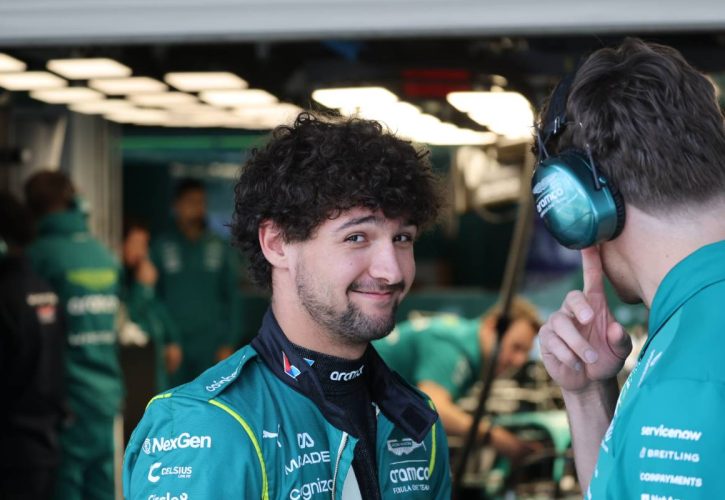
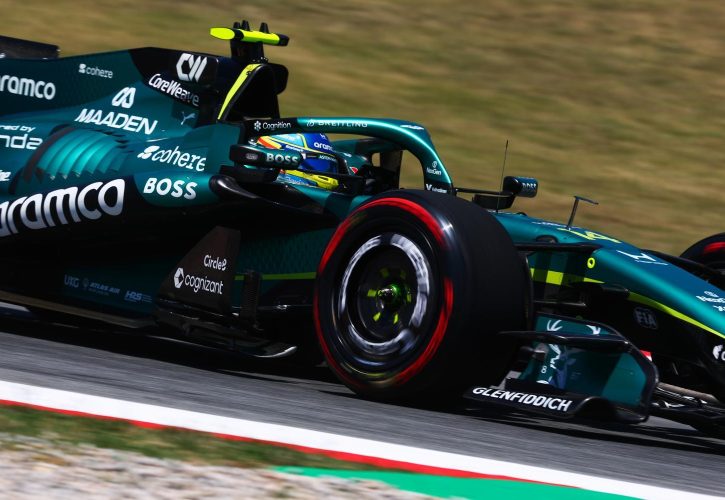
    Aston Martin’s final preseason outing in Bahrain was repeatedly hamstrung by reliability problems that prompted on-track stoppages and cost the team valuable running. The week’s disruptions included Lance Stroll’s spin into the Turn 11 gravel — blamed on a loss of drive while downshifting — which brought the session’s first red flag and required a crane recovery that stopped running for about seven minutes.

    Later in the test Fernando Alonso’s car suffered a power-unit/engine issue and stopped on track, reported at the exit of Turn 4 during a race simulation, forcing another red-flag interruption and leaving Alonso unable to rejoin that stint.

    Those problems left Aston Martin with markedly reduced mileage and patchy programs. Alonso was limited to the stint that ended in the stoppage (most sources recording about 28 laps; one put his total at 34) and was down the order — recorded as 12th and roughly four seconds off the fastest test benchmark — while the team had already logged the fewest laps in the previous week’s Bahrain running. Team engineers attempted to recover running after the failures, but the interruptions, plus an earlier Stroll incident, underlined recurring pace shortfalls and reliability concerns for Aston Martin as teams wrapped up final preseason preparations.

    More
  • Ferrari probes SF-26 after active rear wing flipped

    Ferrari probes SF-26 after active rear wing flipped

    Ferrari’s novel active rear wing — a rotating flap on the SF-26 designed to cut drag — dominated the opening days of the Bahrain pre-season test. Team observers saw the flap rotate fully upside‑down in straight mode during Lewis Hamilton’s brief outing, prompting Ferrari to investigate and adopt a cautious program: one SF‑26 was reported confined to the garage and another was limited to just five laps in a session. Hamilton ran the SF‑26 only briefly, spent much of the morning in the garage, completed five laps in one outing and later returned for a standing‑start exercise.

    On-track timings were tight. Lando Norris set the fastest lap of the test with a 1:33.453 on the C4 tire, edging George Russell’s 1:33.459 by 0.006s; Russell had earlier topped a session with the 1:33.459 on C3 rubber. Oscar Piastri was within 0.01s of Russell, Charles Leclerc posted a 1:33.739 on prototype Pirelli rubber, and Max Verstappen posted a 1:33.584 after more than 50 laps. Mileage leaders included Russell, who was reported to have completed roughly 76-77 laps, while several rookies and backmarkers logged more limited programs (for example, Isack Hadjar completed 66 laps overall).

    Reliability and restricted mileage affected several teams. Aston Martin suffered a power-unit issue that limited Fernando Alonso to about 28 laps and left the team with one of the lower daily totals (around 54 laps reported), while Lance Stroll’s spin brought out a red flag. Cadillac-run entries struggled for consistent track time. Reports about individual drivers’ lap counts varied: some logs showed Sergio Pérez at about 24 laps on one day, while Valtteri Bottas was variously reported as having only two installation laps in one session and higher totals in others. Red Bull also detected a pressure problem at times that curtailed running. Programs were further constrained late in the day by FIA-mandated practice-start checks, leaving teams to balance useful mileage with ongoing technical investigations ahead of the season opener.

    More
  • F1 Commission sends refinements to WMSC; Bahrain checks

    F1 Commission sends refinements to WMSC; Bahrain checks

    The F1 Commission agreed a set of targeted refinements to send to the World Motor Sport Council for approval, and the FIA said it will not make immediate, sweeping changes to the 2026 regulations. The FIA pledged further evaluation rather than wholesale revisions and will run additional energy-management checks across three days at the second pre-season test in Bahrain, examine proposals to reduce any extra risk at standing starts, and evaluate potential updates to race systems and on-car management there.

    Drivers and teams warned the 2026 overhaul could worsen overtaking, drivability and energy management rather than improve racing. Audi’s Gabriel Bortoleto said following another car “doesn’t look great.” Haas’s Esteban Ocon warned the cars appear to lose front load and that, so far, it looks difficult to pass. Max Verstappen dismissed some concerns as “a lot of nothing.”

    Lewis Hamilton amplified technical concerns about drivability and energy recovery, saying teams cannot recover sufficient battery power under the revised hybrid rules and that drivers are being forced to rev very high and drop into first and second gears to regenerate energy. He warned high revs and large gaps between gear ratios raise the risk of instability when a car is loaded mid-corner and can cause sudden snaps, and cited “about 600 meters of lift‑and‑coast at Barcelona” appearing in qualifying. Hamilton also argued the hybrid system now supplies nearly half of the car’s power, making energy deployment and management central to on-track performance.

    Teams, power-unit manufacturers and FOM pledged to work through outstanding technical issues before the season opener in Melbourne. The FIA and many teams also highlighted positive elements of the 2026 cars — reduced weight, smaller dimensions, improved ride quality and stronger initial acceleration — while warning that premature or large-scale regulatory changes could increase instability and that any refinements remain subject to formal approval procedures.

    More
  • Ferrari unveils exhaust flap on SF-26 to boost downforce

    Ferrari unveils exhaust flap on SF-26 to boost downforce

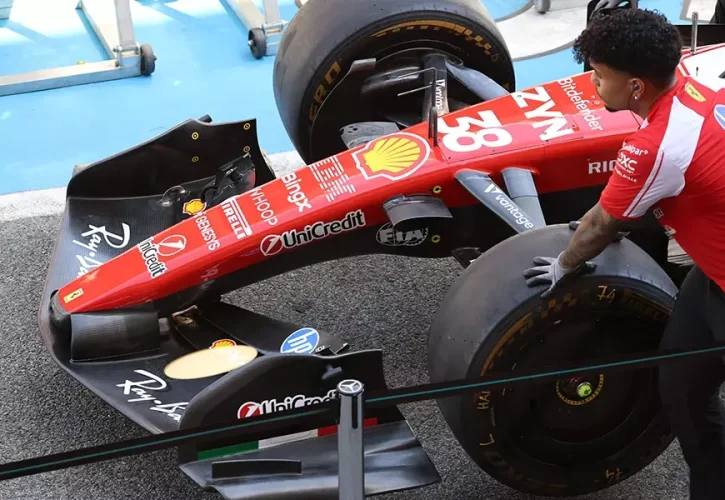
    Ferrari unveiled a novel exhaust-mounted flap on the SF-26 during final pre-season testing in Bahrain. The device, variously described in paddock reports as a full-width flap, a small “flick-up” wing or a miniature beam wing, sits directly behind the tailpipe and around the rear-wing pylons in an area of bodywork that is usually restricted. Ferrari said the flap redirects hot exhaust upward to boost rear-wing efficiency and acts as an extension of an enlarged diffuser to raise rear downforce; the team stressed it interacts with diffuser sub-structures and replaces earlier small winglets, stopping short of calling the solution a blown diffuser. The car also displayed a smaller-than-average exhaust tailpipe with a metal upper section and a visible temperature strip.

    The flap required and received special FIA permission because of its proximity to the rear axle line and because it exploits allowable volumes in the 2026 regulations around the twin rear-wing pillar and tail-section box regions. Ferrari kept the development hidden until Charles Leclerc put the car on track, and Motorsport Italia called the solution “unprecedented.” Rivals immediately noted the concept would likely demand a complete rear-end redesign to replicate — McLaren’s Andrea Stella was reported to have inspected the component at length — and teams said the small performance edge it might provide could persist for months as others chase packaging changes. Several outlets said the late timing of Ferrari’s reveal and the diffuser-extension packaging would make rapid copying ahead of the Australian Grand Prix difficult, though teams with the necessary internal volume could eventually adopt a similar idea.

    Ferrari linked the flap-and-diffuser package to its decision to run a smaller turbo this season to help race starts and continued work on engine and gearbox compatibility and hybrid recharge behavior in first gear during the Bahrain sessions. On-track times gave context but left questions: Charles Leclerc posted the third-quickest time in testing while both Leclerc and Lewis Hamilton trailed Max Verstappen and Red Bull on energy-recovery metrics, underscoring lingering hybrid-performance differences. If the exhaust-mounted flap proves effective in races, Ferrari could gain an early aerodynamic advantage and influence the shape of the F1 2026 aerodynamic battleground before the season begins.

    More
  • Pirelli to Test Wet Tires in Abrasive Bahrain for 2026

    Pirelli to Test Wet Tires in Abrasive Bahrain for 2026

    Pirelli will run an unusual wet-weather tire test at the Bahrain International Circuit from February 28 to March 1 to evaluate and improve its full-wet and intermediate compounds for 2026 development. The program is a response to driver complaints that the current full-wet has been difficult or effectively unusable. Pirelli’s stated objective is to shorten the crossover time between full-wet and intermediate so the full-wet becomes a viable strategic option rather than a last resort.

    The two-day test will use McLaren and Mercedes mule cars, fitted with 2026-like prototype tires matched to the revised 18-inch-wheel F1 cars. Pirelli will evaluate both intermediate and full-wet compounds and adjust constructions and compounds to suit new car dynamics. This will include narrower front and rear tires, higher acceleration forces, and sudden vertical loads when straight-line mode deactivates.

    Bahrain was chosen because its abrasive, high-severity surface will place greater stress on wet rubber and is expected to reveal wear modes and weaknesses that do not appear on European tracks with a permanent sprinkler system. The environment should produce tougher, more representative data for development and race strategy. Pirelli plans three wet sessions in 2026 (Bahrain, Fiorano, and either Paul Ricard or Magny-Cours), and noted that sweeping regulation changes have left it with limited usable data from current cars.

    Wetting the circuit presents a logistical challenge, as sources differ on the method. Some say Bahrain lacks conventional sprinkler tanks and organizers coordinating an alternative full-track wetting system. Other reports suggest that the circuit can be uniformly wet using a full-track sprinkler system, and Pirelli says consistent water levels are essential because inconsistent wetting could skew results. Pirelli is limited to a maximum of 40 testing days, which increases the importance of each wet session. The Bahrain data will directly influence 2026 tire specifications, including whether to retain separate intermediate and full-wet compounds or consolidate to a single “super intermediate.” Pirelli is proceeding with targeted testing even as its future supply position remains under scrutiny.

    More
  • Ferrari moves Adami, leaves Hamilton without race engineer

    Ferrari moves Adami, leaves Hamilton without race engineer

    Ferrari moved Riccardo Adami into a role with the Ferrari Driver Academy earlier this month, leaving Lewis Hamilton without a named race engineer as winter testing began. That timing has raised concern that the gap could hinder Hamilton’s integration and pre-season preparation.

    Former driver-turned-pundit Karun Chandhok said he was “confused and concerned,” warning that the absence of a winter-built relationship between Hamilton and a dedicated engineer was “ringing alarm bells.” Chandhok and other commentators emphasized that a stable driver–engineer bond is crucial for rapid, reliable feedback and in-race decision-making, noting Hamilton’s strong past partnership with Peter Bonnington.

    The provisional arrangement was apparent at the Barcelona shakedown, where Charles Leclerc’s race engineer Bryan Bozzi doubled up and ran Hamilton’s SF-26 while the team organized the change. Hamilton took over the car in the afternoon, completed 57 laps and recorded an unofficial wet-condition best of 1:32.872; the doubling-up highlighted that the current setup is temporary.

    Commentators and former drivers said Ferrari missed an opportunity over the winter to build rapport through simulator days or private runs and suggested Hamilton may need extra simulator or additional track time to catch up if a new pairing is finalized late. Speculation has focused on Cédric Grosjean as Hamilton’s likely replacement, with multiple reports saying Ferrari intends to sign him but may have to wait until his post-McLaren gardening leave ends. Reports differ on his exact McLaren role: some describe him as a lead trackside performance figure, while others link him more directly to Oscar Piastri or to a race-engineer capacity. Sky Sports reporter Craig Slater and other outlets noted there is no official confirmation from Ferrari, and commentators warned that appointing a late or inexperienced engineer could hamper Hamilton’s adaptation under the sport’s new technical rules. Ferrari declined further comment, saying it would provide an update when there was a development.

    More
  • F1 to rotate Barcelona-Catalunya and Spa through 2032

    F1 to rotate Barcelona-Catalunya and Spa through 2032

    F1 announced a rotation deal that will see Circuit de Barcelona‑Catalunya and Spa‑Francorchamps share a single calendar slot on alternate years through 2032. Under the agreement, Spa‑Francorchamps will host the Belgian Grand Prix in 2027, 2029 and 2031, while Barcelona‑Catalunya will host in 2028, 2030 and 2032. The deal formalized a split calendar that preserves both historic venues but ended Barcelona‑Catalunya’s uninterrupted run as the regular host of the Spanish Grand Prix, which had run from 1991–2025, and means Barcelona will drop off the 2027 calendar and return in 2028.

    The arrangements also intersect with the arrival of a new Madrid street race. Organizers said Madrid has taken the official Spanish Grand Prix title, but reporting varies on the precise 2026 allocation: one source said Barcelona‑Catalunya would stage a race in June, another placed Madrid’s Madring event in September, and other reports indicate Madrid will host the Spanish Grand Prix from 2026. Barcelona had entered the final year of its previous contract and faced pressure to upgrade facilities after losing the Spanish Grand Prix title; organizers said the rotation preserves both the Barcelona and Belgian rounds while accommodating the new Madrid event.

    F1 and circuit officials framed the deal as a negotiated, multi‑year solution that keeps both venues on the calendar. Pol Gibert, CEO of Circuits de Catalunya SL, said the renewal consolidated Catalonia on the international calendar; organizers highlighted an estimated economic impact of more than €300 million per edition. F1 CEO Stefano Domenicali said he was “delighted” to continue racing at the circuit and welcomed the ongoing relationship. Organizers added the rotation frees up calendar flexibility — aided by confirmation that Zandvoort will be stepping back — leaving one remaining slot on the planned 24‑race 2027 calendar and opening the possibility for other additions such as Thailand or a return for Istanbul while the wider 2027 schedule is finalized.

    More
  • Russell posts only sub-1:34 as Mercedes probes W17 pace

    Russell posts only sub-1:34 as Mercedes probes W17 pace

    Mercedes used the Bahrain pre-season test to probe the W17’s pace and tire behavior, finishing with George Russell posting the fastest lap of the week — a 1:33.918 on the soft C3 tire — while Lewis Hamilton sat second in the morning order. Russell completed 78 laps in the final morning and handed the car to Kimi Antonelli for afternoon running; the quick one-lap pace, including the only sub-1:34 lap of the session, contrasted with the longer-run work Mercedes prioritized during the test.

    That long-run work included a 58-lap full race simulation by Russell that provided the clearest look at the W17’s tire degradation. On the soft C3s Russell’s first representative lap in the race run was 1:40.4, but lap times drifted into the 1:42s by lap 15 with an in-lap of 1:43.5 on lap 18 — roughly a two-second drop across that stint. The medium C2 stint began with a 1:38.6 and produced consistent 1:39.0–1:39.9 laps for more than a dozen laps, showing only about a 1.3-second drop over that window. The hard C1s produced an opening 1:38.2 and then hovered between 1:39 and 1:40 with the flattest degradation of the day, leading Mercedes to judge the medium and hard compounds more promising for race distance than the softs.

    Mercedes also used the test to recover and collect mileage after earlier reliability and setup issues; the team logged heavy running across the week and the morning programs suggested greater stability and consistency after initial problems. Russell had warned after the opening day that “there’s work for us to do to get the W17 into a happier place,” and the session’s combination of short-run speed and detailed long-run tire data will form the basis of further setup changes and updates ahead of the next test phase.

    More
  • Antonelli leads Mercedes 1-2 in Bahrain test

    Antonelli leads Mercedes 1-2 in Bahrain test

    Mercedes closed out the final day of the opening 2026 Bahrain pre-season test with a one-two, Kimi Antonelli setting the fastest lap of the day and the test. Antonelli took over from George Russell in the afternoon and posted a 1:33.669, eclipsing Russell’s morning benchmark of 1:33.918 by 0.249 seconds; Russell finished second after a 78-lap morning run.

    Ferrari’s Lewis Hamilton was the highest-placed runner behind the Mercedes pair, finishing third after heavy mileage during the day. Hamilton completed roughly 150 laps but stopped on track with just over 10 minutes remaining in the final session, bringing running to an early halt. McLaren’s Oscar Piastri logged in excess of 150 laps and finished fourth, with Red Bull’s Max Verstappen and team-mate Isack Hadjar lining up behind him.

    The final day — and the three-day test overall — produced strong single-lap showings for Mercedes but a confused pecking order, as teams ran differing programs and on-track disruptions (including earlier Cadillac stoppages and the late Hamilton stoppage) curtailed some running. The closing sessions delivered mileage and reliability data across the grid while underlining Mercedes’ apparent one-lap pace advantage heading into the season.

    More