NXTbets Inc

  • Norris tops Antonelli as Piastri completes McLaren front row

    Norris tops Antonelli as Piastri completes McLaren front row

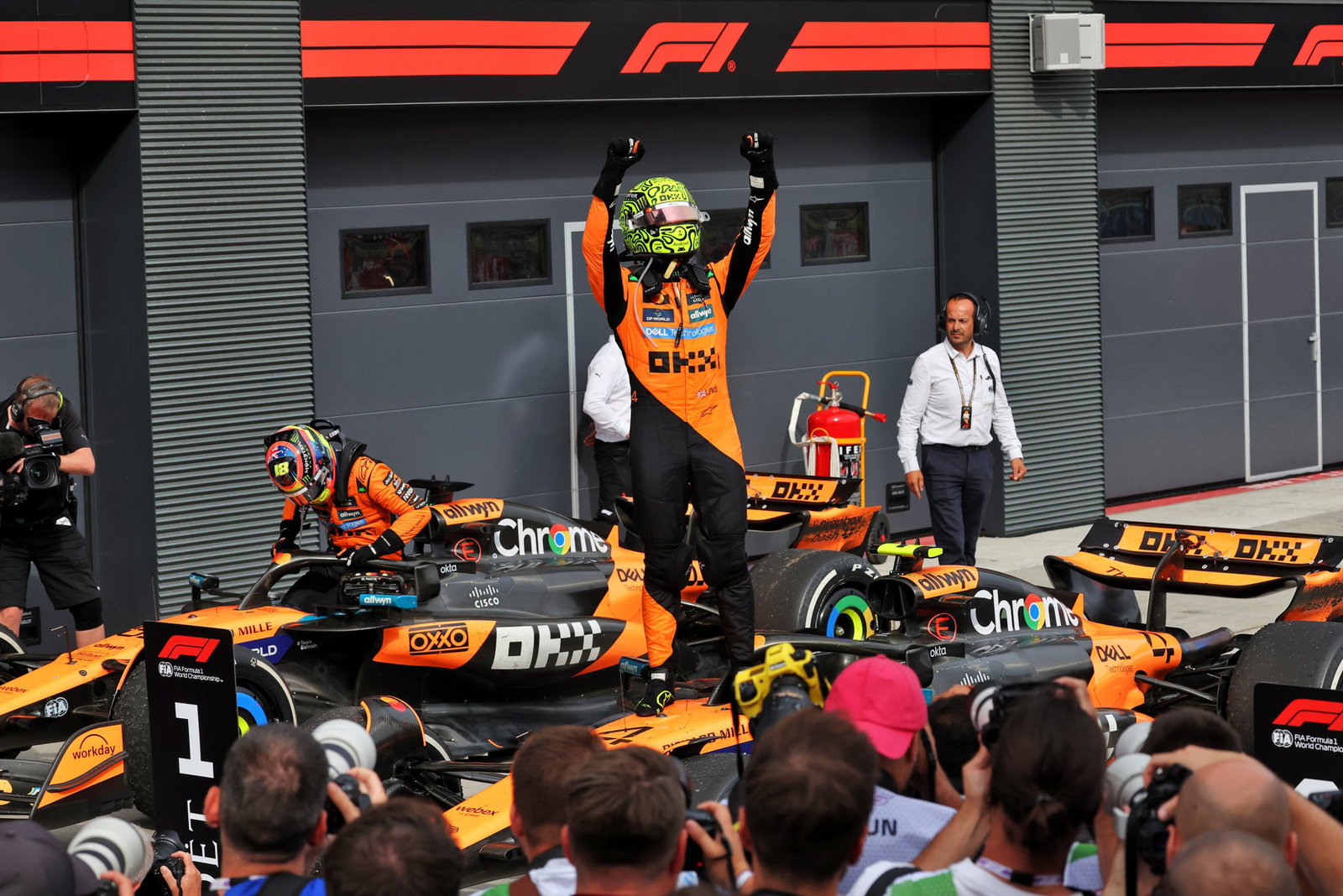
    Lando Norris claimed Sprint pole at the Miami Grand Prix in an upgraded McLaren that returned the team to the front. He set a 1:27.869, edging championship leader Kimi Antonelli by 0.222 seconds. Oscar Piastri completed a McLaren front row in third, 0.239 seconds off Norris, with Charles Leclerc fourth. The result put McLaren on top of this season’s qualifying for the first time and set the grid for Saturday’s Sprint, which will start at 12 p.m. local time.

    Antonelli recovered to second after missing the end of FP1 with an engine issue. He found late pace to narrowly beat Piastri by under 0.02 seconds. Mercedes experienced problems when George Russell reported unusual turbo noises, and the team delayed his SQ1 start while they worked on his power unit. Most outlets reported Lewis Hamilton fifth, while one named Max Verstappen. Russell finished sixth. Pierre Gasly, Franco Colapinto and Isack Hadjar also made the top 10.

    The session featured several disruptions and eliminations. A yellow flag followed Lance Stroll’s heavy lock-up at Turn 17; Aston Martin briefly rebooted his car but then retired it before he could set a time. Fernando Alonso was eliminated in SQ1, roughly 12 seconds slower than Norris. Valtteri Bottas and Sergio Perez were knocked out in the elimination zone, with Perez taken to the garage amid reports of a possible MAC-26 issue. Esteban Ocon was eliminated after a Turn 1 lock-up, and Liam Lawson exited after braking problems.

    More
  • McLaren upgrades restore grip as Norris tops Miami Sprint

    McLaren upgrades restore grip as Norris tops Miami Sprint

    Lando Norris took sprint pole at the Miami Grand Prix, posting a 1:27.869 in SQ3 to beat Mercedes rookie Kimi Antonelli by 0.222 seconds. The result ended Mercedes’ early-season run of poles and put McLaren’s heavily upgraded car back at the front. Norris credited McLaren’s new package with restoring grip, and the session was the first competitive running after a five-week break and the FIA’s mid-season energy-management rule refinement.

    Oscar Piastri split the front of the grid by qualifying third, with Charles Leclerc fourth and Max Verstappen fifth in an updated Red Bull. George Russell and Lewis Hamilton were sixth and seventh, respectively. Alpine’s Franco Colapinto, Red Bull’s Isack Hadjar and Pierre Gasly completed the top ten. Several teams arrived in Miami with major upgrade packages, McLaren running seven upgrades and Ferrari introducing multiple changes, while Mercedes ran a smaller upgrade and said it planned a larger set for the Canadian Grand Prix.

    The results underscored a reshuffle in short-run pace ahead of Saturday’s 19-lap Sprint, with McLaren’s development delivering an immediate gain. The weekend also included factors that affected running, including a practice power-unit issue for Mercedes that limited Antonelli’s soft-tire work and problems for Aston Martin that left Fernando Alonso and Lance Stroll without representative Sprint laps. Sergio Perez and Valtteri Bottas were left at the back of the Sprint qualifying order.

    More
  • Red Bull debuts rotating wing in Miami, denies Ferrari copy

    Red Bull debuts rotating wing in Miami, denies Ferrari copy

    Red Bull ran its rotating “Macarena” rear wing in first practice at the Miami Grand Prix, sparking debate over whether the device copied Ferrari’s concept. The team publicly denied any copying. Ferrari first showed a rotating rear wing in Bahrain pre-season testing, briefly used it in China and tested updated versions at Monza before bringing a new iteration to Miami. Ferrari team principal Laurent Mekies said Red Bull had developed the idea well before putting it on track and had delayed use while addressing larger performance problems.

    Red Bull said it developed and submitted its rotating-wing concept to the FIA in 2025, and tested it at Silverstone and during a filming day, maintaining the design was independently developed. Technically the two solutions differed, with Red Bull’s wing rotating about 160 degrees in the opposite direction to Ferrari’s up-to-270-degree concept and using revised attachments and a modified centerline profile to increase travel, generate lift and reduce drag. Red Bull’s variant featured a noticeably larger actuator and greater travel, which observers said increased the magnitude of the flap movement. Sky Sports’ Ted Kravitz described the device as cutting drag and said it “allows one heck of amount of travel,” and Jenson Button judged Red Bull’s implementation to be considerably faster than Ferrari’s. Red Bull ran the flap in FP1 to assess on-track behavior and aerodynamic benefit ahead of further sessions and potential race deployment.

    The rotating rear wing formed the centerpiece of a seven-part upgrade package for the RB22 that also included front-wing tweaks, revised corner inlets, more aggressively dropped sidepods with a prominent waterslide, an updated engine cover, a new floor and a small “mini” wing on the exhaust inspired by Ferrari developments. The upgrades targeted longstanding balance issues and were expected to roughly halve the car’s initial ~12 kg weight excess, with Red Bull aiming to reach the 768 kg minimum weight by the European rounds, likely Austria or Britain. Early signals from the upgrades were positive in running, and Mekies cautioned fans not to expect miracles after a difficult start to the season.

    More
  • Leclerc leads Miami FP1 as Ferrari upgrade debuts

    Leclerc leads Miami FP1 as Ferrari upgrade debuts

    Charles Leclerc topped the 90-minute FP1 in Miami with a lap of 1:29.310, 0.297 seconds clear of Max Verstappen. Oscar Piastri was third in McLaren’s revised MCL40.

    The FIA granted an extra 30 minutes to Friday’s FP1 under the new sprint regulations, and teams used the extended running to debut major upgrade packages ahead of the compressed weekend. Red Bull brought multiple changes including the ‘Macarena’ wing plus floor and rear-brake work. McLaren ran a heavily revised MCL40 and Piastri used flo-vis paint to gather aero data. Ferrari introduced a substantial update that proved quickest in the session.

    Mercedes fitted only minor upgrades and suffered power-unit concerns. George Russell reported a noisy turbo, pitted with a suspected turbo issue and was late to run, leaving the team down the timesheets. Aston Martin experienced early power-unit and electrical teething problems that initially kept Lance Stroll and Fernando Alonso in the garage before both cars later collected data. The issues raised reliability questions for some Honda-powered runners. Friday’s sprint qualifying will further test the upgrades and any fixes.

    More
  • RacerX, SMX Insider Prepare Fans for Denver Supercross

    Coverage of the AMA Supercross this week focused on storylines and injuries ahead of Round 16 at Empower Field at Mile High in Denver. RacerX published a weekend preview hosted by former Women’s National Champion Sarah Whitmore that outlined key storylines, noted which riders would miss the race due to injury, and directed viewers to Jason Thomas’ track report for deeper analysis. The video served as a brief primer and linked to a full written injury report; it did not announce results or roster changes.

    An SMX Insider video with hosts Jason Weigandt and Jason Thomas reviewed key storylines from Round 15 in Philadelphia and then previewed the Denver Supercross, highlighting matchups and offering host-driven commentary and context.

    Together, the RacerX preview, the SMX Insider recap/preview, and the consolidated injury report aimed to prepare fans for the competitive and logistical context of the upcoming Denver Supercross.

    More
  • FIA Bans Full Electric Boost in Wet for Miami GP

    FIA Bans Full Electric Boost in Wet for Miami GP

    The FIA has banned full electric boost in wet or low-grip conditions for the Miami Grand Prix under Article B7.2.1g (FIA-F1-DOC-058), citing safety concerns with the new hybrid power units. The rule will be applied during the Miami weekend if heavy rain or low-grip conditions materialize, and the FIA said the immediate, weather-triggered measure did not require the usual route through the F1 Commission; teams were reported to have backed broader regulatory tweaks.

    The ban prevents drivers from using full boost mode in the wet, which the FIA’s text says stops access to what had been up to about 350 kW of additional electrical power. To avoid confusion between figures cited in different sources, the 350 kW figure refers to the maximum super-clipping potential; an earlier and agreed package includes a race boost cap of roughly +150 kW and a cut in qualifying energy-harvesting from 8 MJ to 7 MJ. Some reports also referenced alternative wet-power numbers around 250 kW, and the published documents separate the immediate wet-condition prohibition from the wider technical limits in the regulatory package.

    Operationally, the wet ban inhibits boost mode while leaving pre-programmed electrical deployment maps active, a compromise intended to smooth torque delivery but one that could still produce meaningful speed differences between cars. Straightline-mode rules were tightened, Driver Adjustable Bodywork (DAB) will be allowed only for partial activation in designated low-grip zones, and rear wings are to remain in a fixed closed configuration to preserve rear stability and reduce sudden front-drag changes. The broader package also includes an automatic MGU-K start-assist to reduce grid-start risks.

    The changes follow limited wet running in Barcelona, where teams and drivers reported the new power units delivered instant torque that made cars prone to oversteer and produced unpredictable behavior on corner exit and under acceleration in the wet. Heavy rain forecasts gave urgency to the measures, with reported thunderstorm probabilities for Sunday between about 68 percent and 85 percent, and U.S. lightning safety protocols could force delays, stoppages or red-flag interruptions. Teams and drivers met with the FIA to discuss possible schedule adjustments, including an earlier race start, and organizers said contingency plans and shelter would be available inside Hard Rock Stadium and in the team garages. Drivers warned of difficult and counterintuitive wet running with the new cars, and Charles Leclerc said low visibility, divergent power-unit strategies and the need to stay flat-out could leave drivers feeling like “passengers.” Other concerns included difficulty heating tires in the wet, unproven intermediate tires, the Miami track’s poor drainage and standing water, and the risk that removing the wet boost option could expose engine performance differentials among manufacturers. Teams, officials and fans will watch both the weather and the technical implications closely throughout the Miami weekend.

    More
  • Mercedes brings few Miami upgrades, targets Canada

    Mercedes brings few Miami upgrades, targets Canada

    The championship resumed in Miami after an unexpected five-week break that followed the cancellation of the Bahrain and Saudi Arabian rounds. The FIA introduced targeted measures at Miami to help flat-out qualifying laps after the switch to a 50% electric hybrid formula, to reduce unwanted closing-speed differentials, to curb so-called “superclipping” and to improve wet- and start-safety. F1 CEO Stefano Domenicali said the changes were intended to encourage more overtakes. Mercedes team principal Toto Wolff called the adjustments an “evolution” and said officials were “acting with a scalpel.” Organizers and teams warned some technical effects, especially those linked to energy-harvesting deployment, may not become apparent until later rounds such as the Canadian Grand Prix (May 22-24).

    Teams used the five-week development window to push rival upgrade programmes in different directions, making Miami a high-stakes technical crossroads. Mercedes, which had won the opening three races and the Shanghai Sprint, brought a deliberately limited package to Miami and prioritized a larger upgrade targeted for the Canadian Grand Prix. Mercedes staff said they had brought “barely” any upgrades and expected roughly a three-tenths buffer. Antonelli said that approach would give rivals clearer signs of how long Mercedes’ dominance might last. Commentator Jolyon Palmer warned Mercedes risked “standing still” in the development race.

    Ferrari and McLaren moved aggressively. Ferrari introduced a substantial update in Miami and aimed to use the first additional development upgrade opportunity window to secure engine upgrade chances. McLaren split its upgrade programme and promised a “completely new car” for Miami. Ferrari driver Lewis Hamilton said he felt “fired up” for the restart but warned his team remained down on power compared with Mercedes and “probably the Ford” power unit, making the deficit hard to close without new engines. Commentators such as Martin Brundle predicted an “absolutely wild” three-way fight among Ferrari, McLaren and Mercedes.

    The weekend also carried political and regulatory stakes. Officials said they would soon decide whether any of the five power-unit manufacturers would receive catch-up upgrades, a process that has sparked debate involving Wolff and Red Bull’s Laurent Mekies. Wolff and others suggested the rule and energy tweaks were likely to tighten the field and produce a “stronger spectacle,” while some teams and observers warned the fixes may not fully restore previous performance levels. Miami therefore represented an early test of whether aerodynamic updates, power-unit catch-up decisions and the FIA’s mid-season fine-tuning can meaningfully change the competitive balance and improve safety as the season moves toward Canada.

    More
  • Grand Prix Commission bans MotoGP wildcards from 2027

    Grand Prix Commission bans MotoGP wildcards from 2027

    The Grand Prix Commission has banned wildcard entries in the MotoGP class from the 2027 season, removing a development route teams had used to race prototypes and test new materials during Grand Prix weekends. The ban is intended to tighten on-track development pathways and harmonize restrictions across manufacturers, and it carries technical and competitive implications for manufacturers and lower-ranked teams that benefited from the A-D concessions system.

    The restriction applies to all manufacturers regardless of concession rank, and the Commission said that from 2027 test riders may race only when replacing injured full-time riders. Wildcards will remain permitted in Moto2 and Moto3. The Commission also ruled that wildcards entered in 2026 may not run 2027-spec 850cc machinery, effective immediately; Ducati is unaffected because it already could not field wildcards under its existing A concession. The decision followed recent wildcard outings, including Augusto Fernández and Lorenzo Savadori at the Spanish Grand Prix, and Yamaha’s late 2025 wildcard program to develop its V4-powered M1, with Fernández debuting that bike at Misano in 2025.

    The package included technical, operational and safety tweaks. The tire pressure monitoring system will be retained for 2027, and race-procedure changes increase the warm-up lap countdown after a Start Delayed from a three-minute board to a five-minute board. The Commission approved optional heart-rate monitors for Moto2 and Moto3 and issued clarifications on post-injury testing and IMU electronics homologation. These rulings were adopted in Grand Prix Commission meetings earlier this year; some measures take effect immediately, while others will be implemented before or during the 2027 season.

    More
  • Ferrari fix could sharpen Miami threat to Mercedes

    Ferrari fix could sharpen Miami threat to Mercedes

    Ferrari fixed a systems-related straight-line power loss that affected Lewis Hamilton at the Japanese Grand Prix in Suzuka, carrying the correction into the Miami Grand Prix weekend. Hamilton said the problem was not caused solely by Ferrari’s power unit but by a combination of systems and that the fault cost him roughly eight to nine tenths of straight-line speed. He reported a loss of power on track and asked his engineer for help with battery deployment during the race. A safety car initially put him third, but he slipped to sixth after being overtaken by several cars, including his Ferrari teammate Charles Leclerc, who did not suffer the issue and finished third. Hamilton finished 25 seconds behind race winner Andrea Kimi Antonelli and entered Miami fourth in the Drivers’ Championship, eight points behind Leclerc.

    Ferrari used the enforced break between rounds to conduct a deep-dive investigation, traced the root cause beyond the power unit, and implemented a fix ahead of the Miami Grand Prix. The team and Hamilton carried out simulator work and factory training aimed at identifying and resolving the systems interactions responsible for the straight-line deficit. Charles Leclerc also spent days in the factory and many simulator sessions correlating race data, testing the upgrades and adapting to the new cars and rules. Ferrari consolidated those development efforts into planned upgrades designed to improve competitiveness under the new regulations. With Hamilton’s specific issue resolved, the team said it may present a stronger challenge to the Mercedes duo in Miami.

    More